Sunday, July 28, 2013

The easiest & cheapest vintage grain sack pillow covers ever!

As part of my living room refresh project, I decided to update my throw pillows with something more in line with the vintage style I've been loving lately.

Source
Source  

They're just so cozy and homey and lovely. I can't get enough.

I went to Pinterest first and saw a lot of DIY grain sack pillow covers, but I didn't want to deal with finding the perfect linen fabric, then painting/printing/stamping anything on and I don't own a sewing machine.

After looking everywhere online, I wasn't loving the prices of the real deal. I was finding a lot of knock-offs but they just didn't look and feel like the real thing. I knew there had to be a way to make my own without a sewing machine.

Then I started searching for just the grain sacks and found several styles in many different conditions. They started at around $10 on the lower end, all the way up to $50+, depending on the type and condition. I noticed that the width on many of them were the same width of my pillows, and the length was just over double. I figured I'd have the perfect amount of material to make two covers.

I didn't mind a little wear and tear (it just adds to the character!) so I scored a nice vintage 19x42" Bemis sack on Etsy for $22 shipped.


It was perfect.


See where I'm going with this?


The design was right in the center which means it would be split, but I didn't mind the mostly plain pillows at all. If you wanted to center the design you could always pick up two grain sacks or find one with a design at the bottom.


To split it evenly I measured the center and drew a line...


Then I made my cut.


I didn't want the rough cuts showing, so I turned to the one and only Stitch Witchery:


For the first cover that was open on both ends, I had to stitch the bottom shut. I flipped the cover inside out, made sure it was lined up, and ran my stitch witchery across the bottom:


The result:


The top of this cover already had a nice hem from the factory, so I put it aside and addressed the rough cut on the second cover.


For this one I just had to fold the edges onto the inside all the way around the opening.


And that was that! I ended up with two perfect pillows with one open end...


I didn't want to close the seam permanently because then I could never wash the covers or swap them out down the road. I couldn't sew a zipper on either, so I thought about sewing buttons on it and almost went for it, but then I remembered these pillows I purchased from Ikea because I loved the little bows:


So I went through my leftover fabric stash and found some linen:


I cut it into six strips, then made little notches about 1" down with my Xacto knife:


Then I threaded each tie through and made knots:


And in less than one hour, I had my very own vintage grain sack pillows:


Ahhh... I love them. They're the perfect addition to our home, and specifically our updated couch... more on that next week!


Sunday, July 21, 2013

The 7 Hour Pond

Let me preface this post by saying this is a Brad project. It was his idea and execution (he even took half the photos)... I simply contributed some manual labor and a few opinions. And this post.

Summer is upon us and we've been turning our attention to the outdoors lately—prepping the backyard for pool parties and gatherings.

The latest project came about when our neighbor had several large rocks he was getting rid of from his yard. Brad offered to take them off his hands which sparked the idea of building a rock pond.

We already have one lovely pond back there (the real reason we bought the house...)


But you can never have enough water features, so Brad picked a spot and started to plan it out.

This underutilized patch of bark and random shrubbery was the perfect location:


Here it is from a distance:


Here are the rocks we inherited, and the overall layout and size we thought worked best after Brad cleared out the bark.


Mission #1 was to figure out exactly how to build the pond. Brad did some research and tossed around ideas of using rubber liner, concrete and liquid rubber, or a plastic pre-molded pond. After weighing the options, we both decided a plastic pond was the easiest way to go (and cheaper, too).

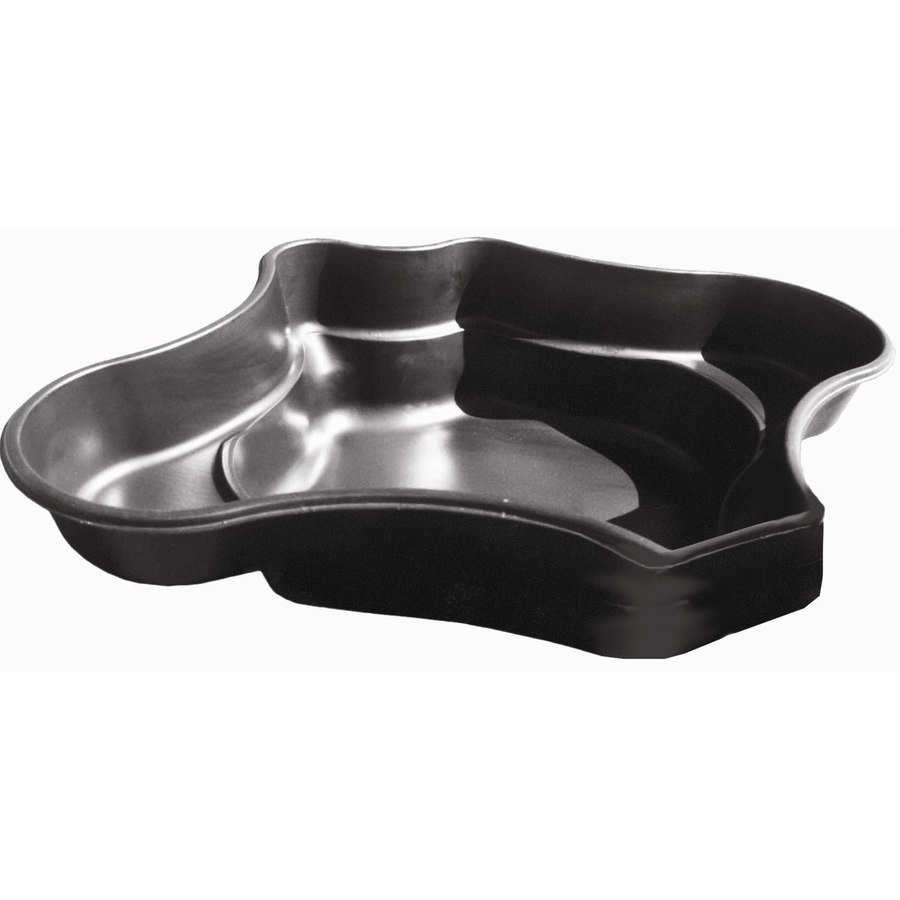
A quick Google search brought up this pond at Lowe's for $99.

It was the perfect size and a nice shape, so Brad picked it up on his way home from work.


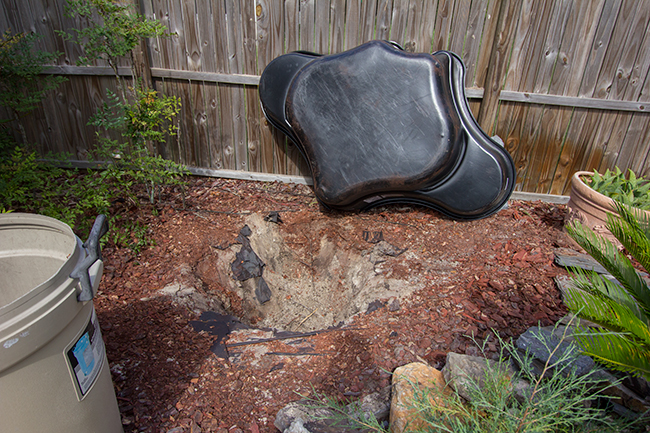
Then it was time to dig....


Not gonna lie, this part sucked. It was a painstaking process to dig everything out perfectly to the shape of the pond. The process was basically dig, test fit, dig, test fit, dig, test fit, dig test fit, repeated 300x for over two hours.


Lucky for us, we live in an area where the top layer of earth is just soft sand. We were also lucky that we didn't run into any surprises... like roots or pipes. My shovel actually hit of one of our pool pipes but it was right on the edge of our pond area and just barely out of the way... whew!

Finally, we got that sucker in.


After cleaning it out and replacing the dirt/bark around the edges, we started filling up and arranging the rocks around the edges.


We quickly realized we didn't have enough, so Brad went to the landscaping store the next day and bought another 160lbs more.

But a rock pond is not complete without a few things—a filter, a pump, and some plants.

Brad purchased this UV filter complete with a fountain from Lowe's for $129.


The UV light inside the filter cleans algae and keeps the water aerated. It also has a fountain and LED lighting which Brad thought was the coolest thing ever. It even changes water patterns.


My favorite part is the waterfall. For this, Brad picked up a simple pump at Lowe's and 5 feet of clear hose for $45:


To build the waterfall, we stacked the largest rocks at the back of the pond and strategically fed the tube up and over, (hidden by the rocks so you can't see it) keeping the pump submerged at the bottom.

For the finishing touches, Brad got a few water plants as well as a handful of other plants to landscape the surrounding area.

And after two afternoons and about 7 hours of work, our pond oasis is complete!


Don't mind our gator... he doesn't bite (too hard).


Here's a couple evening/night shots to show off the lighting:


Project materials cost breakdown: 
Pond: $99
Filter/fountain: $129
Pump/hose: $45
Rocks: $27 (we paid 17 cents per pound, most were free)
Water plants: $50
Landscaping flowers: $27
Grand Total: $377

Not the cheapest project, but still a whole lot better than paying a landscaping company! I'd say it was a good call on Brad's part. I'm glad one of us takes initiative on outdoor projects.

Working on some new living room accents for the next post... check back soon for that!


Sunday, July 14, 2013

Easy DIY $50 Gallery Wall


Guys, I just found a new favorite way to fill an entire wall on the cheap. And it's easy. And personalized. And I did it all in one afternoon for around $50...


I've been pinning these gorgeous monochromatic gallery walls for quite some time now...

Source
Source

Source


Source

Ahhh.... like a breath of fresh air. So when we ended up with this large bare wall in our new master bedroom...

Paint color is Valspar's Urban Sunrise, more photos here


I knew exactly what I wanted to do. What I didn't want to do, however, was spend hundreds on this project—and if you've ever been shopping for large matted frames, you know how pricey they can be.

On my last road trip to Ikea, I couldn't pass up the opportunity to pick up six of these large Nyttja frames in black:


I loved the simple thin frame and most of all, the price! It was just $7.99 for the 21x21" which was the perfect size for my wall. Right now they are only $4.99 with the Friends and Family discount! Insane, right? If you're lucky enough to live near an Ikea—walk, don't run, to your local store and stock up! You can never have too many.

Here's one frame in all its glory:


As you might notice, it doesn't include a mat. But there's an easy fix:


I picked up a 10 sheet pack of white posterboard at Michael's for just $3 after a 40% off coupon. Super score. 

To turn the sheets into a mat, I simply removed the backing from the frame and traced the outside of it onto a sheet:


Then I used my Xacto knife and ruler to cut it out. Easy peasy.

I wanted the mats to make a statement so I kept the picture opening on the small side, settling on a 6" square.

After lots of precise measurements, I cut out my square in the center of the sheet the same way I cut the outside shape.

Here's Susie modeling my fancy new mat:


I could have just skipped this step and taped or glued my photos in the center, but I wanted this to be as realistic as possible and also make sure everything was perfectly centered. It will also make things easier down the line if I decide to switch out my photos.

After I had my first mat made, I used it as a template and traced it onto the remaining five sheets. In no time at all, my mats were ready to rock:


For the photos, I decided to go with a water theme and gathered some of my favorite instagram photos from our travels—Mexico, California, Mississippi, Florida and Costa Rica.

I opened them all in photoshop, scaled them to size (slightly larger than the mat opening for necessary overlap), and ran a simple black and white filter over them.


I printed them out on a sheet of 13x19 paper...


And trimmed them down:


To keep them secure, I placed a couple pieces of tape on the back:


Voila!


All that was left to do was put the frames back together...


Legit. 

I laid everything out to admire my work and decide on an arrangement. Susie helped oversee this process.


Next comes the part I always dread... attempting to line everything up on the wall. I decided to try out a new method this time and picked up a roll of butcher paper from Lowe's:


It was just wide enough and I have 135 feet leftover to use for other projects, yay!

First I trimmed off a piece several feet long and and spread the sheet onto a flat surface. While my frames were on the ground and I had them spaced out accordingly (around 2" between the frames), I measured from one nail position to the other and made my markings on the paper:


This is just one of those things where everyone has to figure out what works best for them. 

Once I was confident I had my marks in the correct spot, it was time to hang the paper up on the wall (I had my sister help with this one).


I used a level on the top and bottom to make sure it was perfectly straight.

Then I just hammered my nails into the markings I had made:


Once all six were up, I ripped the paper off leaving the nails behind, and hung my frames. This is so much easier than any other method I've used! Make all your markings on paper so you don't have to mess up your walls. Genius.

Tip—if your frames are slightly off, you can gently hammer the nail in the direction you want to go. I had to do this for one frame because the hanger wasn't exactly in the same position as the others (I guess that's what comes with a $7 frame... oh well). 

Tip 2—to keep the frames hanging straight, use a bit of tape looped together to gently hold it in place at the bottom:


These frames are so lightweight and easy to move out of place since they are hanging by just one nail, so this little bit of tape is perfect to hold them steady without damaging the wall.

For a couple hours of easy work and around $50, our room went from this:


to this:


I've been doin' a happy dance ever since. I just love the classy yet personalized touch it adds to the room. Just a few more projects to go until I can call this space finished!

Hopefully this post can help solve someone else's empty-wall syndrome... I really can't think of anything better to spend $50 on!


Linking up to That DIY Party!